Section 39-2 Review Jawless and Cartilaginous Fishes Answers
| Cartilaginous fishes Temporal range: Tardily Silurian to Present | |
|---|---|
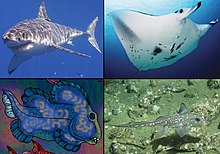 | |
| Example of cartilaginous fishes: Elasmobranchii at the pinnacle of the image and Holocephali at the bottom of the prototype. | |
Scientific classification  | |
| Kingdom: | Animalia |
| Phylum: | Chordata |
| Subphylum: | Vertebrata |
| Infraphylum: | Gnathostomata |
| Clade: | Eugnathostomata |
| Class: | Chondrichthyes Huxley, 1880 |
| Subclasses and orders | |
| |
Chondrichthyes (; from Ancient Greek χόνδρος (khóndros) 'cartilage', and ἰχθύς (ikhthús) 'fish') is a class that contains the cartilaginous fishes that have skeletons primarily composed of cartilage. They tin can be contrasted with the Osteichthyes or bony fishes, which have skeletons primarily composed of bone tissue. Chondrichthyes are jawed vertebrates with paired fins, paired nares, scales, and a heart with its chambers in series. Extant chondrichthyes range in size from the x cm (iii.9 in) finless sleeper ray to the 10 k (32 ft) whale shark.
The course is divided into two subclasses: Elasmobranchii (sharks, rays, skates, and sawfish) and Holocephali (chimaeras, sometimes called ghost sharks, which are sometimes separated into their own form).
Within the infraphylum Gnathostomata, cartilaginous fishes are distinct from all other jawed vertebrates.
Anatomy [edit]
Skeleton [edit]
The skeleton is cartilaginous. The notochord is gradually replaced past a vertebral column during development, except in Holocephali, where the notochord stays intact. In some deepwater sharks, the cavalcade is reduced.[3]
Equally they practise not accept bone marrow, reddish blood cells are produced in the spleen and the epigonal organ (special tissue around the gonads, which is also idea to play a role in the immune arrangement). They are also produced in the Leydig's organ, which is merely found in sure cartilaginous fishes. The subclass Holocephali, which is a very specialized group, lacks both the Leydig'due south and epigonal organs.
Appendages [edit]
Apart from electric rays, which accept a thick and flabby trunk, with soft, loose pare, chondrichthyans have tough skin covered with dermal teeth (again, Holocephali is an exception, as the teeth are lost in adults, only kept on the clasping organ seen on the caudal ventral surface of the male), too called placoid scales (or dermal denticles), making it feel like sandpaper. In most species, all dermal denticles are oriented in one direction, making the skin feel very smooth if rubbed in one direction and very crude if rubbed in the other.
Originally, the pectoral and pelvic girdles, which do not contain whatever dermal elements, did not connect. In later forms, each pair of fins became ventrally continued in the middle when scapulocoracoid and puboischiadic bars evolved. In rays, the pectoral fins are connected to the caput and are very flexible.
1 of the chief characteristics nowadays in nigh sharks is the heterocercal tail, which aids in locomotion.[4]
Body roofing [edit]
Chondrichthyans have tooth-similar scales called dermal denticles or placoid scales. Denticles usually provide protection, and in most cases, streamlining. Mucous glands exist in some species, too.
It is assumed that their oral teeth evolved from dermal denticles that migrated into the rima oris, just it could be the other manner around, every bit the teleost bony fish Denticeps clupeoides has most of its head covered by dermal teeth (as does, probably, Atherion elymus, another bony fish). This is most likely a secondary evolved feature, which means there is not necessarily a connectedness between the teeth and the original dermal scales.
The old placoderms did not have teeth at all, but had sharp bony plates in their rima oris. Thus, it is unknown whether the dermal or oral teeth evolved outset. It has even been suggested[ by whom? ] that the original bony plates of all vertebrates are at present gone and that the present scales are just modified teeth, even if both the teeth and torso armor had a common origin a long time ago. However, there is currently no evidence of this.
Respiratory organisation [edit]
All chondrichthyans exhale through five to seven pairs of gills, depending on the species. In general, pelagic species must keep swimming to keep oxygenated water moving through their gills, whilst demersal species can actively pump water in through their spiracles and out through their gills. However, this is just a general rule and many species differ.
A spiracle is a small hole establish behind each eye. These tin can be tiny and circular, such equally establish on the nurse shark (Ginglymostoma cirratum), to extended and slit-like, such as institute on the wobbegongs (Orectolobidae). Many larger, pelagic species, such as the mackerel sharks (Lamnidae) and the thresher sharks (Alopiidae), no longer possess them.
Nervous arrangement [edit]

Regions of a Chondrichthyes brain colored and labeled on dissected skate. The rostral finish of the skate is to the correct.
In chondrichthyans, the nervous system is composed of a small brain, 8-10 pairs of cranial fretfulness, and a spinal chord with spinal nerves.[5] They have several sensory organs which provide information to be processed. Ampullae of Lorenzini are a network of pocket-sized jelly filled pores called electroreceptors which help the fish sense electric fields in water. This aids in finding prey, navigation, and sensing temperature. The Lateral line system has modified epithelial cells located externally which sense motion, vibration, and pressure in the water around them. Virtually species have large well-developed eyes. Also, they have very powerful nostrils and olfactory organs. Their inner ears consist of 3 large semicircular canals which aid in balance and orientation. Their sound detecting apparatus has express range and is typically more powerful at lower frequencies. Some species have electric organs which can be used for defence force and predation. They accept relatively simple brains with the forebrain not greatly enlarged. The structure and formation of myelin in their nervous systems are well-nigh identical to that of tetrapods, which has led evolutionary biologists to believe that Chondrichthyes were a cornerstone group in the evolutionary timeline of myelin evolution.[half dozen]
Allowed system [edit]
Like all other jawed vertebrates, members of Chondrichthyes have an adaptive immune system.[7]
Reproduction [edit]
Fertilization is internal. Development is usually alive nascence (ovoviviparous species) but can be through eggs (oviparous). Some rare species are viviparous. There is no parental care later birth; however, some chondrichthyans practice guard their eggs.
Capture-induced premature birth and abortion (collectively called capture-induced parturition) occurs oftentimes in sharks/rays when fished.[8] Capture-induced parturition is ofttimes mistaken for natural nascency by recreational fishers and is rarely considered in commercial fisheries management despite being shown to occur in at least 12% of live begetting sharks and rays (88 species to date).[8]
Classification [edit]
The grade Chondrichthyes has two subclasses: the subclass Elasmobranchii (sharks, rays, skates, and sawfish) and the bracket Holocephali (chimaeras). To see the full list of the species, click here.
| Subclasses of cartilaginous fishes | ||
|---|---|---|
| Elasmobranchii |  | Elasmobranchii is a subclass that includes the sharks and the rays and skates. Members of the elasmobranchii have no swim bladders, five to seven pairs of gill clefts opening individually to the outside, rigid dorsal fins, and small placoid scales. The teeth are in several series; the upper jaw is non fused to the attic, and the lower jaw is articulated with the upper. The eyes have a tapetum lucidum. The inner margin of each pelvic fin in the male person fish is grooved to constitute a clasper for the manual of sperm. These fish are widely distributed in tropical and temperate waters.[nine] |
| Holocephali |  | Holocephali (complete-heads) is a subclass of which the order Chimaeriformes is the merely surviving group. This grouping includes the rat fishes (e.g., Chimaera), rabbit-fishes (e.one thousand., Hydrolagus) and elephant-fishes (Callorhynchus). Today, they preserve some features of elasmobranch life in Paleaozoic times, though in other respects they are aberrant. They live close to the bottom and feed on molluscs and other invertebrates. The tail is long and thin and they movement by sweeping movements of the large pectoral fins. There is an erectile spine in front of the dorsal fin, sometimes poisonous. At that place is no tum (that is, the gut is simplified and the 'tummy' is merged with the intestine), and the mouth is a small aperture surrounded by lips, giving the head a parrot-similar appearance. The fossil record of the Holocephali starts in the Devonian period. The record is extensive, but most fossils are teeth, and the torso forms of numerous species are not known, or at best poorly understood. |
| Extant orders of cartilaginous fishes | ||||||||||||
|---|---|---|---|---|---|---|---|---|---|---|---|---|
| Grouping | Order | Image | Common proper name | Authorization | Families | Genera | Species | Annotation | ||||
| Total |  |  |  | |||||||||
| Galean sharks | Carcharhiniformes | 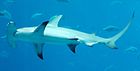 | footing sharks | Compagno, 1977 | viii | 51 | >270 | vii | 10 | 21 | ||
| Heterodontiformes | 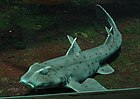 | bullhead sharks | L. S. Berg, 1940 | 1 | 1 | nine | ||||||
| Lamniformes | 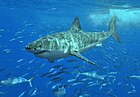 | mackerel sharks | L. Due south. Berg, 1958 | seven +2 extinct | 10 | sixteen | 10 | |||||
| Orectolobiformes |  | carpet sharks | Applegate, 1972 | vii | 13 | 43 | 7 | |||||
| Squalomorph sharks | Hexanchiformes | 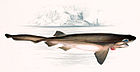 | frilled and cow sharks | de Buen, 1926 | two +3 extinct | iv +xi extinct | seven +33 extinct | |||||
| Pristiophoriformes |  | sawsharks | L. Due south. Berg, 1958 | ane | 2 | half dozen | ||||||
| Squaliformes |  | dogfish sharks | Goodrich, 1909 | 7 | 23 | 126 | 1 | vi | ||||
| Squatiniformes |  | affections sharks | Buen, 1926 | 1 | 1 | 24 | 3 | 4 | 5 | |||
| Rays | Myliobatiformes | 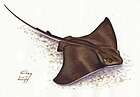 | stingrays and relatives | Compagno, 1973 | x | 29 | 223 | i | 16 | 33 | ||
| Rhinopristiformes | 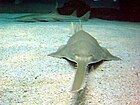 | sawfishes | 1 | 2 | v-7 | 5-7 | ||||||
| Rajiformes |  | skates and guitarfishes | L. S. Berg, 1940 | 5 | 36 | >270 | 4 | 12 | 26 | |||
| Torpediniformes |  | electric rays | de Buen, 1926 | 2 | 12 | 69 | 2 | nine | ||||
| Holocephali | Chimaeriformes | 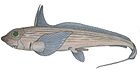 | chimaera | Obruchev, 1953 | 3 +ii extinct | 6 +3 extinct | 39 +17 extinct | |||||
| Taxonomy according to Leonard Compagno, 2005[ten] with additions from [eleven] |
|---|
* position uncertain |
Evolution [edit]
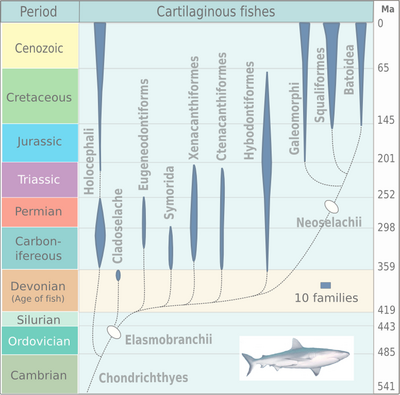
Cartilaginous fish are considered to have evolved from acanthodians.[ by whom? ] Originally causeless[ by whom? ] to be closely related to bony fish or a polyphyletic assemblage leading to both groups, the discovery of Entelognathus and several examinations of acanthodian characteristics indicate that bony fish evolved directly from placoderm similar ancestors, while acanthodians stand for a paraphyletic assemblage leading to Chondrichthyes. Some characteristics previously thought to be exclusive to acanthodians are also present in basal cartilaginous fish.[13] In particular, new phylogenetic studies find cartilaginous fish to exist well nested among acanthodians, with Doliodus and Tamiobatis being the closest relatives to Chondrichthyes.[14] Recent studies vindicate this, every bit Doliodus had a mosaic of chondrichthyian and acanthodiian traits.[15]
Dating back to the Center and Late Ordovician Menstruation, many isolated scales, made of dentine and bone, take a structure and growth form that is chondrichthyan-like. They may exist the remains of stem-chondrichthyans, but their nomenclature remains uncertain.[sixteen] [17] [18]
The primeval unequivocal fossils of cartilaginous fishes showtime appeared in the fossil tape by about 430 million years ago, during the middle Wenlock Epoch of the Silurian catamenia. The radiations of elasmobranches in the nautical chart on the right is divided into the taxa: Cladoselache, Eugeneodontiformes, Symmoriida, Xenacanthiformes, Ctenacanthiformes, Hybodontiformes, Galeomorphi, Squaliformes and Batoidea.
Past the beginning of the Early on Devonian, 419 one thousand thousand years ago, jawed fishes had divided into three singled-out groups: the now extinct placoderms (a paraphyletic assemblage of ancient armoured fishes), the bony fishes, and the clade that includes spiny sharks and early cartilaginous fish. The modernistic bony fishes, class Osteichthyes, appeared in the tardily Silurian or early Devonian, about 416 meg years ago. The first abundant genus of shark, Cladoselache, appeared in the oceans during the Devonian Period. The get-go Cartilaginous fishes evolved from Doliodus-like spiny shark ancestors.
A Bayesian analysis of molecular information suggests that the Holocephali and Elasmoblanchii diverged in the Silurian (421 one thousand thousand years agone) and that the sharks and rays/skates split up in the Carboniferous (306 million years ago).
| | Devonian (419–359 mya) | |||||||
|---|---|---|---|---|---|---|---|---|
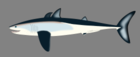 | Cladoselache | Cladoselache was the showtime abundant genus of primitive chondrichthyan, appearing about 370 Ma.[20] Information technology is always introduced as sharks, but recent study shows that it is relatively shut to modern chimaeras.[21] Information technology grew to 6 feet (1.8 grand) long, with anatomical features similar to modern mackerel sharks. Information technology had a streamlined trunk almost entirely devoid of scales, with v to vii gill slits and a short, rounded snout that had a terminal mouth opening at the front of the skull.[20] Information technology had a very weak jaw joint compared with mod-twenty-four hours sharks, just it compensated for that with very potent jaw-closing muscles. Its teeth were multi-cusped and smooth-edged, making them suitable for grasping, only not tearing or chewing. Cladoselache therefore probably seized prey by the tail and swallowed it whole.[twenty] It had powerful keels that extended onto the side of the tail stalk and a semi-lunate tail fin, with the superior lobe about the same size as the junior. This combination helped with its speed and agility which was useful when trying to outswim its probable predator, the heavily armoured 10 metres (33 ft) long placoderm fish Dunkleosteus.[xx] | ||||||
| Carbon- iferous | Carboniferous (359–299 Ma): Sharks underwent a major evolutionary radiation during the Carboniferous.[22] It is believed that this evolutionary radiations occurred because the decline of the placoderms at the end of the Devonian period caused many environmental niches to get unoccupied and allowed new organisms to evolve and make full these niches.[22] | |||||||
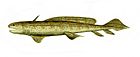 | Orthacanthus senckenbergianus | The first 15 million years of the Carboniferous has very few terrestrial fossils. This gap in the fossil record, is called Romer's gap after the American palaentologist Alfred Romer. While it has long been debated whether the gap is a result of fossilisation or relates to an actual consequence, recent work indicates that the gap catamenia saw a driblet in atmospheric oxygen levels, indicating some sort of ecological collapse.[23] The gap saw the demise of the Devonian fish-like ichthyostegalian labyrinthodonts, and the rise of the more advanced temnospondyl and reptiliomorphan amphibians that so typify the Carboniferous terrestrial vertebrate creature. The Carboniferous seas were inhabited by many fish, mainly Elasmobranchs (sharks and their relatives). These included some, similar Psammodus, with crushing pavement-like teeth adapted for grinding the shells of brachiopods, crustaceans, and other marine organisms. Other sharks had piercing teeth, such every bit the Symmoriida; some, the petalodonts, had peculiar cycloid cut teeth. Virtually of the sharks were marine, simply the Xenacanthida invaded fresh waters of the coal swamps. Among the bony fish, the Palaeonisciformes found in coastal waters also appear to have migrated to rivers. Sarcopterygian fish were also prominent, and one group, the Rhizodonts, reached very large size. Most species of Carboniferous marine fish have been described largely from teeth, fin spines and dermal ossicles, with smaller freshwater fish preserved whole. Freshwater fish were abundant, and include the genera Ctenodus, Uronemus, Acanthodes, Cheirodus, and Gyracanthus. | ||||||
 | Stethacanthidae | Equally a event of the evolutionary radiation, carboniferous cartilaginous fish assumed a wide variety of bizarre shapes; eastward.g., sharks belonging to the family Stethacanthidae possessed a apartment brush-like dorsal fin with a patch of denticles on its top.[22] Stethacanthus' unusual fin may have been used in mating rituals.[22] Apart from the fins, Stethacanthidae resembled Falcatus (below). | ||||||
 | Falcatus | Falcatus is a genus of small cladodont-toothed cartilaginous fish which lived 335–318 Ma. They were nigh 25–xxx cm (nine.eight–11.8 in) long.[24] They are characterised by the prominent fin spines that curved anteriorly over their heads. | ||||||
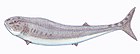 | Orodus | Orodus is another cartilaginous fish of the Carboniferous, a genus from the family Orodontidae that lived into the early on Permian from 303 to 295 Ma. It grew to 2 one thousand (six.six ft) in length. | ||||||
| Permian | Permian (298–252 Ma): The Permian ended with the most all-encompassing extinction event recorded in paleontology: the Permian-Triassic extinction result. 90% to 95% of marine species became extinct, equally well as 70% of all country organisms. Recovery from the Permian-Triassic extinction result was protracted; state ecosystems took 30M years to recover,[25] and marine ecosystems took even longer.[26] | |||||||
| Triassic | Triassic (252–201 Ma): The fish fauna of the Triassic was remarkably compatible, reflecting the fact that very few families survived the Permian extinction. In turn, the Triassic ended with the Triassic–Jurassic extinction event. Near 23% of all families, 48% of all genera (20% of marine families and 55% of marine genera) and 70% to 75% of all species became extinct.[27] | |||||||
| Jurassic | Jurassic (201–145 Ma): | |||||||
| Cretaceous | Cretaceous (145–66 Ma): The end of the Cretaceous was marked past the Cretaceous–Paleogene extinction outcome (K-Pg extinction). There are substantial fossil records of jawed fishes across the K–T boundary, which provides skillful prove of extinction patterns of these classes of marine vertebrates. Within cartilaginous fish, approximately 80% of the sharks, rays, and skates families survived the extinction event,[28] and more ninety% of teleost fish (bony fish) families survived.[29] | |||||||
 | Squalicorax falcatus | Squalicorax falcatus is a lamnoid shark from the Cretaceous | ||||||
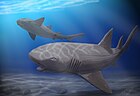 | Ptychodus | Ptychodus is a genus of extinct shark (previously considered equally hybodontiform but denied[30]) which lived from the late Cretaceous to the Paleogene.[31] [32] Ptychodus mortoni (pictured) was well-nigh 32 feet (9.viii meters) long and was unearthed in Kansas, United States.[33] | ||||||
| Cenozoic Era | Cenozoic Era (65 Ma to present): The current era has seen nifty diversification of bony fishes. | |||||||
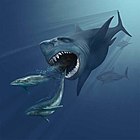 | Megalodon |
Megalodon is an extinct species of shark that lived well-nigh 28 to 1.5 Ma. Information technology looked much like a stocky version of the nifty white shark, merely was much larger with estimated lengths reaching 20.3 metres (67 ft).[34] Found in all oceans[35] it was one of the largest and nearly powerful predators in vertebrate history,[34] and probably had a profound impact on marine life.[36] | ||||||

 Megalodon battle History Channel
 | Extinct orders of cartilaginous fishes | |||||||||
|---|---|---|---|---|---|---|---|---|---|
| Group | Order | Epitome | Common proper name | Dominance | Families | Genera | Species | Note | |
| Holocephali | †Orodontiformes | ||||||||
| †Petalodontiformes | 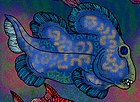 | ||||||||
| †Helodontiformes | |||||||||
| †Iniopterygiformes |  | ||||||||
| †Debeeriiformes | |||||||||
| †Symmoriida | 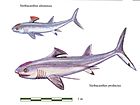 | [37] | |||||||
| †Eugeneodonti formes | 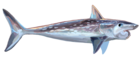 | [38] | |||||||
| †Psammodonti formes | Position uncertain | ||||||||
| †Copodontiformes | |||||||||
| †Squalorajiformes | |||||||||
| †Chondrenchelyi formes | |||||||||
| †Menaspiformes | |||||||||
| †Coliodontiformes | |||||||||
| Squalomorph sharks | †Protospinaci- formes | ||||||||
| Other | †Squatinactiformes | 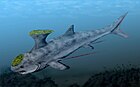 | |||||||
| †Protacrodonti- formes | |||||||||
| †Cladoselachi- formes |  | ||||||||
| †Xenacanthiformes |  | ||||||||
| †Ctenacanthi- formes |  | ||||||||
| †Hybodontiformes | | ||||||||
Taxonomy [edit]
Subphylum Vertebrata └─Infraphylum Gnathostomata ├─Placodermi — extinct (armored gnathostomes) └Eugnathostomata (truthful jawed vertebrates) ├─Acanthodii (stem cartilaginous fish) └─Chondrichthyes (true cartilaginous fish) ├─Holocephali (chimaeras + several extinct clades) └Elasmobranchii (shark and rays) ├─Selachii (true sharks) └─Batoidea (rays and relatives)
- Note: Lines show evolutionary relationships.
See also [edit]
- Listing of cartilaginous fish
- Cartilaginous versus bony fishes
- Largest cartilaginous fishes
- Threatened rays
- Threatened sharks
- Placodermi
References [edit]
- ^ Botella, H.A.; Donoghue, P.C.J.; Martínez-Pérez, C. (2009). "Enameloid microstructure in the oldest known chondrichthyan teeth". Acta Zoologica. 90 (Supplement): 103–108. doi:10.1111/j.1463-6395.2008.00337.x.
- ^ "Chondrichthyes". PalaeoDB. Retrieved 26 November 2013.
- ^ Sharks of the World: An Annotated and Illustrated Catalogue of Shark Species Known to Date
- ^ Wilga, C. D.; Lauder, G. V. (2002). "Function of the heterocercal tail in sharks: quantitative wake dynamics during steady horizontal swimming and vertical maneuvering". Journal of Experimental Biology. 205 (sixteen): 2365–2374. doi:10.1242/jeb.205.16.2365. PMID 12124362.
- ^ Collin, Shaun P. (2012). "The Neuroecology of Cartilaginous Fishes: Sensory Strategies for Survival". Brain, Behavior and Evolution. lxxx (2): 80–96. doi:ten.1159/000339870. ISSN 1421-9743. PMID 22986825. S2CID 207717002.
- ^ de Bellard, Maria Elena (15 June 2016). "Myelin in cartilaginous fish". Brain Research. 1641 (Pt A): 34–42. doi:10.1016/j.brainres.2016.01.013. ISSN 0006-8993. PMC4909530. PMID 26776480.
- ^ Flajnik, M. F.; Kasahara, M. (2009). "Origin and evolution of the adaptive immune arrangement: genetic events and selective pressures". Nature Reviews Genetics. 11 (1): 47–59. doi:ten.1038/nrg2703. PMC3805090. PMID 19997068.
- ^ a b Adams, Kye R.; Fetterplace, Lachlan C.; Davis, Andrew R.; Taylor, Matthew D.; Knott, Nathan A. (Jan 2018). "Sharks, rays and ballgame: The prevalence of capture-induced parturition in elasmobranchs". Biological Conservation. 217: eleven–27. doi:x.1016/j.biocon.2017.10.010. Archived from the original on 23 February 2019. Retrieved xviii January 2019.
- ^ Bigelow, Henry B.; Schroeder, William C. (1948). Fishes of the Western North Atlantic. Sears Foundation for Marine Research, Yale Academy. pp. 64–65. ASIN B000J0D9X6.
- ^ Leonard Compagno (2005) Sharks of the World. ISBN 9780691120720.
- ^ Haaramo, Mikko. Chondrichthyes – Sharks, Rays and Chimaeras . Retrieved 22 October 2013.
- ^ Benton, Chiliad. J. (2005). Vertebrate Palaeontology (third ed.). Blackwell. Fig 7.13 on page 185. ISBN978-0-632-05637-eight.
- ^ Min Zhu; Xiaobo Yu; Per Erik Ahlberg; Brian Choo; Jing Lu; Tuo Qiao; Qingming Qu; Wenjin Zhao; Liantao Jia; Henning Blom; You lot'an Zhu (2013). "A Silurian placoderm with osteichthyan-like marginal jaw bones". Nature. 502 (7470): 188–193. Bibcode:2013Natur.502..188Z. doi:ten.1038/nature12617. PMID 24067611. S2CID 4462506.
- ^ Burrow, CJ; Den Blaauwen, J.; Newman, MJ; Davidson, RG (2016). "The diplacanthid fishes (Acanthodii, Diplacanthiformes, Diplacanthidae) from the Centre Devonian of Scotland". Palaeontologia Electronica. doi:10.26879/601.
- ^ Maisey, John M.; Miller, Randall; Pradel, Alan; Denton, John S.S.; Bronson, Allison; Janvier, Philippe (2017). "Pectoral Morphology in Doliodus: Bridging the 'Acanthodian'-Chondrichthyan Divide" (PDF). American Museum Novitates (3875): i–fifteen. doi:x.1206/3875.1. S2CID 44127090.
- ^ Andreev, Plamen S.; Coates, Michael I.; Shelton, Richard M.; Cooper, Paul R.; Smith, K. Paul; Sansom, Ivan J. (2015). "Ordovician chondrichthyan-similar scales from Northward America". Palaeontology. 58 (4): 691–704. doi:x.1111/pala.12167.
- ^ Sansom, Ivan J.; Davies, Neil S.; Coates, Michael I.; Nicoll, Robert S.; Ritchie, Alex (2012). "Chondrichthyan-like scales from the Middle Ordovician of Commonwealth of australia". Palaeontology. 55 (2): 243–247. doi:10.1111/j.1475-4983.2012.01127.x.
- ^ Andreev, Plamen; Coates, Michael I.; Karatajūtė-Talimaa, Valentina; Shelton, Richard One thousand.; Cooper, Paul R.; Wang, Nian-Zhong; Sansom, Ivan J. (2016). "The systematics of the Mongolepidida (Chondrichthyes) and the Ordovician origins of the clade". PeerJ. 4: e1850. doi:x.7717/peerj.1850. PMC4918221. PMID 27350896.
- ^ a b c d The Marshall Illustrated Encyclopedia of Dinosaurs and Prehistoric Animals 1999, p. 26. sfn error: no target: CITEREFThe_Marshall_Illustrated_Encyclopedia_of_Dinosaurs_and_Prehistoric_Animals1999 (help)
- ^ Coates, Michael I.; Finarelli, John A.; Sansom, Ivan J.; Andreev, Plamen S.; Criswell, Katharine E.; Tietjen, Kristen; Rivers, Marking L.; La Riviere, Patrick J. (ten January 2018). "An early chondrichthyan and the evolutionary assembly of a shark body plan". Proceedings of the Regal Order B: Biological Sciences. 285 (1870): 20172418. doi:ten.1098/rspb.2017.2418. ISSN 0962-8452. PMC5784200. PMID 29298937.
- ^ a b c d R. Aidan Martin. "A Golden Age of Sharks". Biology of Sharks and Rays . Retrieved 26 Nov 2013.
- ^ Ward, P.; Labandeira, C.; Laurin, M.; Berner, R. A. (2006). "Confirmation of Romer's Gap is a low oxygen interval constraining the timing of initial arthropod and vertebrate terrestrialization". Proceedings of the National Academy of Sciences. 103 (45): 16818–16822. Bibcode:2006PNAS..10316818W. doi:ten.1073/pnas.0607824103. PMC1636538. PMID 17065318.
- ^ "Archived copy". Archived from the original on 21 August 2008. Retrieved 4 September 2008.
{{cite spider web}}: CS1 maint: archived copy as title (link) Fossil Fish of Bear Gulch 2005 by Richard Lund and Eileen Grogan Accessed 2009-01-xiv - ^ Sahney, S.; Benton, M.J. (2008). "Recovery from the almost profound mass extinction of all time". Proceedings of the Royal Society B. 275 (1636): 759–65. doi:10.1098/rspb.2007.1370. PMC2596898. PMID 18198148.
- ^ Baez. John (2006) Extinction Academy of California. Retrieved twenty January 2013.
- ^ "extinction". Math.ucr.edu. Retrieved 26 November 2013.
- ^
- ^ Patterson, C (1993). Osteichthyes: Teleostei. In: The Fossil Record 2 (Benton, MJ, editor). Springer. pp. 621–656. ISBN978-0-412-39380-8.
- ^ Hoffman, Brian L.; Hageman, Scott A.; Claycomb, Gregory D. (2016). "Scanning electron microscope examination of the dental enameloid of the Cretaceous durophagous shark Ptychodus supports neoselachian classification". Periodical of Paleontology. 90 (4): 741–762. doi:10.1017/jpa.2016.64. ISSN 0022-3360.
- ^ Fossils (Smithsonian Handbooks) by David Ward (Page 200)
- ^ The paleobioloy Database Ptychodus entry accessed on 8/23/09
- ^ "Giant predatory shark fossil unearthed in Kansas". BBC - World News. 24 February 2010.
- ^ a b Wroe, Due south.; Huber, D. R.; Lowry, M.; McHenry, C.; Moreno, K.; Clausen, P.; Ferrara, T. L.; Cunningham, E.; Dean, M. Northward.; Summers, A. P. (2008). "Iii-dimensional estimator analysis of white shark jaw mechanics: how hard can a great white bite?" (PDF). Periodical of Zoology. 276 (iv): 336–342. doi:10.1111/j.1469-7998.2008.00494.10.
- ^ Pimiento, Catalina; Dana J. Ehret; Bruce J. MacFadden; Gordon Hubbell (10 May 2010). Stepanova, Anna (ed.). "Ancient Nursery Area for the Extinct Behemothic Shark Megalodon from the Miocene of Panama". PLOS ONE. v (5): e10552. Bibcode:2010PLoSO...510552P. doi:10.1371/journal.pone.0010552. PMC2866656. PMID 20479893.
- ^ Lambert, Olivier; Bianucci, Giovanni; Mail, Klaas; de Muizon, Christian; Salas-Gismondi, Rodolfo; Urbina, Mario; Reumer, Jelle (1 July 2010). "The giant bite of a new raptorial sperm whale from the Miocene epoch of Peru". Nature. 466 (7302): 105–108. Bibcode:2010Natur.466..105L. doi:x.1038/nature09067. PMID 20596020. S2CID 4369352.
- ^ Coates, 1000.; Gess, R.; Finarelli, J.; Criswell, Thou.; Tietjen, M. (2016). "A symmoriiform chondrichthyan braincase and the origin of chimaeroid fishes". Nature. 541 (7636): 208–211. Bibcode:2017Natur.541..208C. doi:10.1038/nature20806. PMID 28052054. S2CID 4455946.
- ^ Tapanila, L; Pruitt, J; Pradel, A; Wilga, C; Ramsay, J; Schlader, R; Didier, D (2013). "Jaws for a spiral-molar coil: CT images reveal novel adaptation and phylogeny in fossil Helicoprion". Biology Letters. nine (2): 20130057. doi:10.1098/rsbl.2013.0057. PMC3639784. PMID 23445952.
Further reading [edit]
- Taxonomy of Chondrichthyes
- Images of many sharks, skates and rays on Morphbank
levinsonspeargons.blogspot.com
Source: https://en.wikipedia.org/wiki/Chondrichthyes
0 Response to "Section 39-2 Review Jawless and Cartilaginous Fishes Answers"
Post a Comment