what does it mean for a good to be elastic?
Defining Toll Elasticity of Need
The price elasticity of demand (PED) measures the change in demand for a good in response to a change in price.
Learning Objectives
Define the price elasticity of demand.
Key Takeaways
Key Points
- The PED is the percentage alter in quantity demanded in response to a one percent alter in toll.
- The PED coefficient is usually negative, although economists often ignore the sign.
- Demand for a skillful is relatively inelastic if the PED coefficient is less than one (in absolute value).
- Need for a good is relatively elastic if the PED coefficient is greater than one (in absolute value).
- Demand for a proficient is unit elastic when the PED coefficient is equal to one.
Key Terms
- elastic: Demand for a practiced is elastic when a change in price has a relatively big upshot on the quantity of the good demanded.
- Unit of measurement Elastic: Need for a adept is unit elastic when the percentage change in quantity demanded is equal to the per centum change in price.
- inelastic: Demand for a good is inelastic when a modify in toll has a relatively small result on the quantity of the good demanded.
The price elasticity of need (PED) is a measure that captures the responsiveness of a good'southward quantity demanded to a alter in its price. More specifically, it is the percentage change in quantity demanded in response to a ane percent change in cost when all other determinants of demand are held constant.
The formula for the coefficient of PED is:
[latex]PED\quad =\quad \frac { \%\quad change\quad in\quad quantity\quad demanded }{ \%\quad change\quad in\quad price\quad } \\ \\ [/latex]
The law of demand states that in that location is an inverse relationship between price and need for a adept. As a outcome, the PED coefficient is almost always negative. Even so, economists tend to ignore the sign in everyday use. Only goods that do non conform to the police force of demand, such as Veblen and Giffen goods, accept a positive PED.
The numerical values for the PED coefficient could range from cypher to infinity. In general, the need for a good is said to exist inelastic (or relatively inelastic) when the PED is less than one (in absolute value): that is, changes in price take a less than proportional effect on the quantity of the good demanded. The need for a proficient is said to be elastic (or relatively elastic) when its PED is greater than ane. In this instance, changes in price have a more than proportional effect on the quantity of a practiced demanded.
A PED coefficient equal to one indicates demand that is unit elastic; any modify in cost leads to an exactly proportional change in demand (i.e. a 1% reduction in need would lead to a 1% reduction in toll).
A PED coefficient equal to zero indicates perfectly inelastic demand. This ways that need for a good does not change in response to cost.
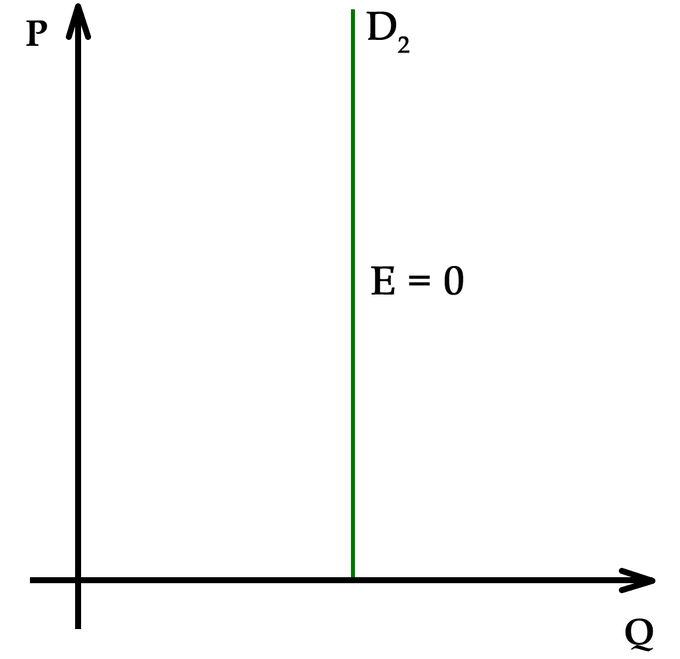
Perfectly Inelastic Demand: When need is perfectly inelastic, quantity demanded for a practiced does not modify in response to a change in price.
Finally, need is said to be perfectly rubberband when the PED coefficient is equal to infinity. When demand is perfectly elastic, buyers will simply buy at one price and no other.
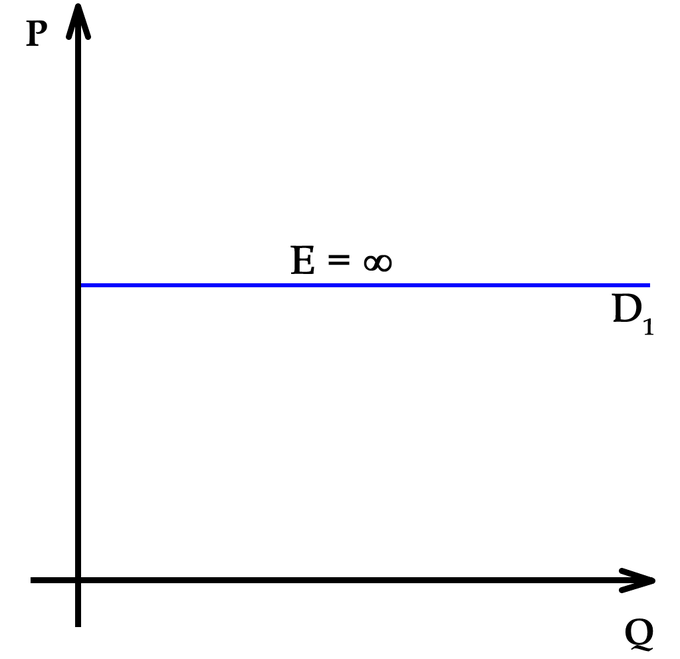
Perfectly Elastic Demand: When the need for a good is perfectly elastic, whatever increase in the price will cause the demand to drop to zero.
Measuring the Price Elasticity of Demand
The price elasticity of demand (PED) is calculated by dividing the per centum modify in quantity demanded by the percentage change in price.
Learning Objectives
Calculate the own-price elasticity of demand
Key Takeaways
Key Points
- PED captures the alter in quantity demanded in response to a modify in the good's own price (as opposed to the price of some other good).
- The formula for cost elasticity yields a value that is negative, pure, and ranges from aught to negative infinity.
- The issue provided by the formula will be authentic only if the changes in price and quantity demanded are pocket-sized.
Key Terms
- Own-price elasticity of demand: Responsiveness of quantity demanded to a modify in the skillful's ain toll
- Cross-price elasticity of demand: Measures the responsiveness of the demand for a practiced to a change in the price of another good.
The price elasticity of demand (PED) captures how cost-sensitive consumers are for a given production or service by measuring the responsiveness of quantity demanded to changes in the good's own price. This is in contrast to measuring the responsiveness of the good'due south demand to a change in cost for some other good (a complement or substitute), which is called the cross-price elasticity of demand. The own-price elasticity of demand is frequently simply chosen the toll elasticity.
The following formula is used to calculate the ain-price elasticity of demand:
[latex]Elasticity\quad =\quad \frac { \%\quad Change\quad in\quad Quantity\quad Demanded\quad }{ \%\quad Change\quad in\quad Cost }[/latex]
The formula above usually yields a negative value considering of the inverse relationship between toll and quantity demanded. However, economists oft disregard the negative sign and report the elasticity as an absolute value. For instance, if the price of a proficient increases past 5 percentage and the quantity demanded decreases by 5 percent, then the elasticity at the initial price and quantity is -5%/5% = -i. This number is probable to be reported simply every bit one.

Sale: There is an inverse relationship between toll and quantity demanded, so the elasticity coefficient is almost always negative.
There are a few other important points to note virtually the coefficient value provided by this formula. First, the elasticity coefficient is a pure number, significant that it does non take units of measurement associated with it. Second, the coefficient value can range from zippo to negative infinity. Finally, the outcome provided past the formula volition be accurate but when the changes in cost and quantity are pocket-size. The result volition be less accurate when the changes are large.
Since PED is based off of pct changes, the starting nominal quantity and price matter. At low prices and high quantities, the PED is therefore more inelastic. For example, a drop in the price of $one from a starting toll of $100 is a i% driblet, but if the starting price is $10, it is a 10% drop. Similarly, at high prices and depression quantities, PED is more rubberband.
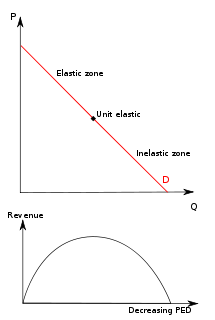
Price Elasticity of Demand and Revenue: PED is based off of percentage changes, and then the starting nominal values of toll and quantity are significant.
Interpretations of Cost Elasticity of Need
The price elasticity of need (PED) explains how much changes in price touch changes in quantity demanded.
Learning Objectives
Describe the relationship between cost elasticity and the shape of the demand curve.
Key Takeaways
Key Points
- Elastic PED can be interpreted as consumers being very sensitive to changes in cost.
- Inelastic PED can be interpreted as consumes being insensitive to changes in price.
- Firms use PED to figure out how to change their prices in order to increase revenue.
- PED varies along a straight demand curve.
Key Terms
- Price elasticity of demand: The percentage change in quantity demanded due to a ane% change in price.
The price elasticity of demand (PED) is a measure of the responsiveness of the quantity demanded of a good to a change in its price. It tin be calculated from the following formula:
[latex]\frac{\%Change \; in \; Quantity \; Demanded}{\%Change \; in \; Price}[/latex]
When PED is greater than one, demand is elastic. This tin be interpreted as consumers being very sensitive to changes in toll: a 1% increase in price volition atomic number 82 to a drop in quantity demanded of more than 1%.
When PED is less than one, demand is inelastic. This tin be interpreted as consumers existence insensitive to changes in price: a one% increment in price will lead to a driblet in quantity demanded of less than 1%.
The effect of toll changes on total revenue PED may exist important for businesses attempting to distinguish how to maximize revenue For example, if a business finds out its PED is very inelastic, information technology may want to raise its prices because it knows that it can sell its products for a college price without losing many sales. Conversely, if a business concern finds that its PED is very rubberband, information technology may wish to lower its prices. This would allow the business organization to dramatically increment the number of units sold without losing much revenue per unit.
At that place are two notable cases of PED. The first is when demand is perfectly rubberband. Perfectly elastic demand is represented graphically as a horizontal line. In this case, whatever increase in price will lead to zero units demanded.
Perfectly Elastic Need: Perfectly elastic demand is represented graphically by a horizontal line. In this case the PED value is the same at every bespeak of the demand curve.
The 2nd is perfectly inelastic demand. Perfectly inelastic demand is graphed as a vertical line and indicates a price elasticity of goose egg at every signal of the curve. This means that the same quantity will be demanded regardless of the price.
Perfectly Inelastic Demand: Perfectly inelastic need is graphed as a vertical line. The PED value is the same at every point of the demand curve.
Since PED is measured based on percent changes in price, the nominal price and quantity hateful that demand curves have unlike elasticities at different points forth the bend. Elasticity along a direct line demand curve varies from nada at the quantity axis to infinity at the price axis. Beneath the midpoint of a straight line demand curve, elasticity is less than one and the firm wants to raise price to increase full revenue. Above the midpoint, elasticity is greater than one and the firm wants to lower price to increase full revenue. At the midpoint, E1, elasticity is equal to 1, or unit elastic.
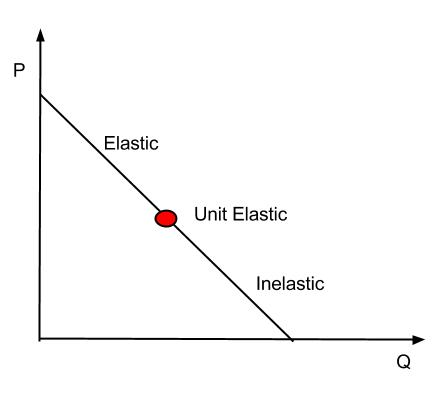
Elasticity and the Demand Curve: The cost elasticity of demand for a good has different values at different points on the demand curve.
Determinants of Cost Elasticity of Demand
A good'due south toll elasticity of demand is largely determined past the availability of substitute goods.
Learning Objectives
Explicate how a good'due south price elasticity of demand may be different in the brusk term than in the long term
Key Takeaways
Key Points
- A proficient with more than close substitutes will likely have a higher elasticity.
- The higher the percent of a consumer's income used to pay for the product, the higher the elasticity tends to be.
- For non-durable goods, the longer a price change holds, the higher the elasticity is likely to exist.
- The more than necessary a good is, the lower the price elasticity of demand.
Key Terms
- Substitute Good: A good that fulfills a consumer need in a way that is similar to some other good.
The price elasticity of demand (PED) is a measure out of how much the quantity demanded changes with a change in cost. The PED for a given good is adamant by one or a combination of the post-obit factors:
- Availability of substitute appurtenances: The more possible substitutes there are for a given good or service, the greater the elasticity. When several close substitutes are available, consumers can easily switch from one good to another even if there is only a small change in toll. Conversely, if no substitutes are bachelor, demand for a skillful is more probable to be inelastic.
- Proportion of the purchaser's budget consumed past the item: Products that eat a large portion of the purchaser'south budget tend to have greater elasticity. The relative high cost of such appurtenances will cause consumers to pay attention to the purchase and seek substitutes. In contrast, demand will tend to be inelastic when a adept represents merely a negligible portion of the budget.
- Degree of necessity: The greater the necessity for a adept, the lower the elasticity. Consumers will attempt to purchase necessary products (e.grand. disquisitional medications similar insulin) regardless of the toll. Luxury products, on the other manus, tend to accept greater elasticity. Nonetheless, some goods that initially have a low caste of necessity are habit-forming and can get "necessities" to consumers (east.grand. coffee or cigarettes).
- Duration of toll modify: For non-durable goods, elasticity tends to be greater over the long-run than the short-run. In the short-term it may be difficult for consumers to notice substitutes in response to a cost modify, merely, over a longer time period, consumers can accommodate their beliefs. For example, if in that location is a sudden increase in gasoline prices, consumers may continue to fuel their cars with gas in the brusk-run, simply may lower their demand for gas by switching to public transportation, carpooling, or ownership more fuel-efficient vehicles over a longer period of fourth dimension. However, this trend does not agree for consumer durables. The demand for durables (cars, for example) tends to be less elastic, as it becomes necessary for consumers to replace them with time.
- Latitude of definition of a expert: The broader the definition of a good, the lower the elasticity. For case, potato fries accept a relatively high elasticity of demand because many substitutes are bachelor. Food in general would have an extremely low PED because no substitutes exist.
- Make loyalty: An attachment to a certain brand (either out of tradition or because of proprietary barriers) can override sensitivity to price changes, resulting in more inelastic need.
levinsonspeargons.blogspot.com
Source: https://courses.lumenlearning.com/boundless-economics/chapter/price-elasticity-of-demand/
0 Response to "what does it mean for a good to be elastic?"
Post a Comment